Six Volunteers and an Orca: A Conversation with the OrcaSlicer Team
How a hobby fork became the slicer of choice for millions of makers — and where its creators think 3D printing goes next.

How a hobby fork became the slicer of choice for millions of makers — and where its creators think 3D printing goes next.
Earlier this month, Snapmaker launched the Snapmaker Innovation Fund — a $150,000 commitment to the builders of the 3D printing ecosystem. We've committed $50,000 to six pioneering projects, including OrcaSlicer, Klipper, Moonraker, Fluidd, Full Spectrum, and Surface Color Stitch, with a further $100,000 open competition for hardware and software developers building things that push the whole industry forward.
OrcaSlicer is close to our hearts: it's the foundation of Snapmaker Orca, the slicer that ships with our U1 multi-color printer, and Snapmaker is now a major sponsor of the project. So to mark the launch, we sat down with the people behind it: SoftFever, OrcaSlicer's creator and lead maintainer; core developers Ian and Yunus; and Radu, creator of Full Spectrum, the color-mixing technology that has taken the multi-color printing world by storm.
What followed was 90 minutes on orcas and dreams, regressions and battle robots, whether software beats hardware upgrades, and what it will take to get true full-color FDM printing. The conversation has been edited for clarity and length, and reviewed by all participants.
What's in a name?

BLAYNE (Snapmaker): Where does the name "Orca" come from? Why an orca?
SOFTFEVER: It's funny — when I had to pick a name, one picture just jumped into my head. First, I wanted to pay respect to the lineage of slicers that came before: Slic3r, PrusaSlicer, SuperSlicer. They all share that naming DNA. And while I was thinking about that, I had this image in my mind of an orca using its fluke like a blade — cutting an object clean in half. It slices. So: OrcaSlicer.
BLAYNE: My best ideas come to me in dreams too. I go to sleep and wake up with vivid ideas. I always tell my boss he should let me sleep in if he wants truly great work.
From hobby to phenomenon
BLAYNE (Snapmaker): Why were you looking at the world of 3D printing and thinking, "these existing slicers aren't good enough — I can do something different"? What inspired these delusions of grandeur?
SOFTFEVER: [laughs] It really started as a personal hobby. A few years ago I built my first printer — a Voron 2.4, open source, took me about seven months to finish. Then, like everyone, I tried to make my prints perfect. I spent a lot of money upgrading the hardware: different belts, different gears, new mods. And honestly? None of it made a noticeable difference in quality.
That's when I realized the biggest improvements weren't coming from hardware at all — they were in the software, in the slicing, in the parameters. The open source community shares an enormous amount of knowledge about what to tune and why. Learning along the way, I started having my own ideas for improvements — things that didn't exist in any slicer. So I started modifying them myself.
BLAYNE (Snapmaker): Which slicers were you tinkering with before Orca existed?
SOFTFEVER: All of them. I'm like a curious kid — I tried Cura, PrusaSlicer, SuperSlicer, and I'd modified all of them locally. Not anything serious; I just wanted a feature, so I'd add it. Checking how each one handled different problems was part of the hobby.
BLAYNE (Snapmaker): So you were dabbling in upgrading the older slicers. Why did you then go all the way and build a whole fork of Bambu Studio?
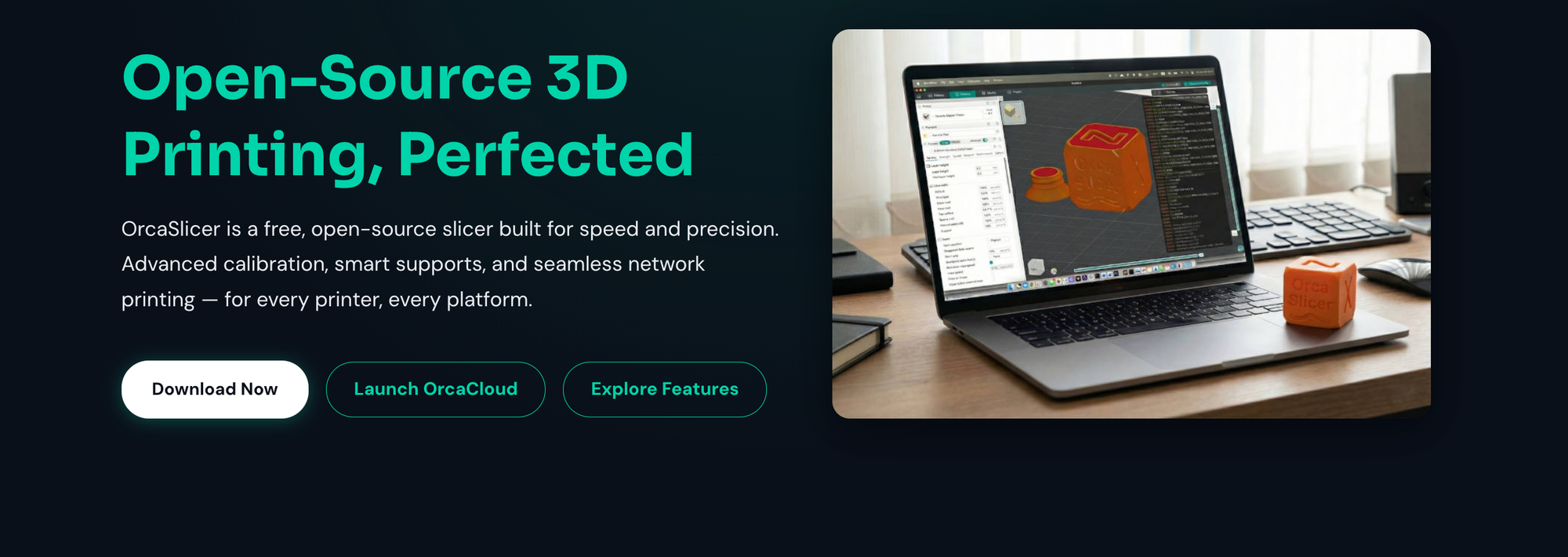
SOFTFEVER: The biggest reason was the User Interface. I particularly liked their take on the interface — that influential sidebar layout. I had joined their Kickstarter and was waiting for my X1C, and when I looked at Bambu Studio, I saw they'd taken the PrusaSlicer core and heavily modified it to suit only their printers. And I thought: I like this User Interface. Maybe I can make it work for my Voron as well.
YUNUS: That sidebar makes everything so much easier compared to PrusaSlicer or Cura. And since then we've added a huge number of our own User Interface improvements on top — at this point I'd say Orca is the easier slicer to use, full stop.
BLAYNE (Snapmaker): When did you realize OrcaSlicer was becoming its own thing — not just a couple of changes you were playing with?
SOFTFEVER: It's hard to point at a moment, because until quite recently it still felt like a hobby. Almost all our communication as a team happened on GitHub — pull requests, issues, very loose coordination, everyone contributing in their personal time. But around a year and a half ago, the scale started to put real pressure on me. Two years ago I could still clear the pull request queue, participate in every discussion, do careful code review on everything. Then the volume of contributions exploded and I realized: I can't manage all of this anymore. I felt a little ashamed when we hit 200 open pull requests.
IAN: When I saw the number I was honestly fine with it — a lot of those PRs are really old. And let's be honest about the codebase: it's a fork of a fork. We joke about it all the time. There's legacy code in there that nobody fully understands — well, maybe SoftFever does. So for new contributors it's genuinely hard. The AI coding tools made the queue explode — they let a lot of people open pull requests for everything they can imagine, and often the implementation isn't quite there. So we spend a lot of time guiding people to improve their PRs. But the main goal is staying open to contributions from everyone. The filament features improvement we shipped recently started as one user's pull request — it wasn't mergeable as-is, but it gave us the idea, and we built on it.
The engineering nobody sees
BLAYNE (Snapmaker): What's the hardest engineering problem in OrcaSlicer right now — something users never see or think about, but that drives you insane?
IAN: Linux. I love Linux, but… Linux.
SOFTFEVER: Keeping the software stable. Every time you merge a new feature, you risk creating new regressions — and that is incredibly hard when you support this many printers, this many features, and users with completely different habits and combinations of settings. There are hundreds of parameters. Change one behavior and you affect another behavior somewhere else. Someone raises an issue saying a new behavior is a must-have, someone even submits a PR that makes them happy — and the moment you merge it, a different group of users surfaces saying you broke their workflow. Deciding what to add and what not to add takes genuinely sophisticated thinking.
IAN: We had a perfect example yesterday. Rodrigo found a small issue, found a fix, did a quick test — works! — and merged it. About an hour later he had to revert it, because it broke the tool changer. Catching that kind of regression requires a lot of testing. We work on alpha channels, release betas, and the truth is the real testing starts when a stable release goes out and people actually use it. Our small group of testers can't catch every bug.
BLAYNE (Snapmaker): Orca's calibration suite is one of its signature features. What's your philosophy on calibration — granular control over every detail, versus "it should just work"?
SOFTFEVER: Wow. Okay, this is hard to answer in one sentence. There's no runbook here, no checklist that spits out an answer — sometimes, like Steve Jobs said, you have to build an intuition for these questions. You're always weighing the trade-off: this adds more granular control, more parameters — but does it deliver meaningful user value? And then the follow-up: what is user value? When one person says "this is super useful, I use it every day," you have to make a judgment call. Is this an edge case for one personal workflow, or will it benefit ten percent of users? Half of users?
I have a product manager background, so on one hand we say: listen to the users. On the other hand — Steve Jobs again — users don't always know what they want. A user's underlying problem is always valid, but users often jump straight to their solution. They don't describe the problem; they say "I want this feature, because it lets me do this." A good PM digs into what the actual problem is, and then you can judge whether their request is the right fix or whether there's a better way. Because the customer can absolutely mislead you in the wrong direction while being completely sincere.
Here's a recent example. We got a PR adding per-feature flow rate adjustment — separate flow for outer walls, inner walls, top surface, solid infill, all of it. I was very reluctant. This is exactly the "just work" versus "granular control" question: we already model flow carefully, we'd already exposed a lot of control, and if you run our calibrations you get great prints. Why would anyone need this? Some people in the PR gave good reasoning; some just insisted. Eventually we merged it — and then Maker's Muse made an incredible video showing exactly the niche it serves: he builds battle robots and needs absurdly strong prints. In hindsight it adds real value for people who know what they want, without bothering the other 99% of users. That's the judgment call, every time. And you keep an open mind — even when you decide not to merge something, if better use cases surface later, you can reopen it.
IAN: That's also exactly why we added the new Expert mode. Before, there was Basic and Advanced, and the gap between them was huge. Now with Expert — plus the Developer option — a casual user can load a model and hit print, and a real power user gets every bit of flexibility. That flexibility is actually why I started using Orca in the first place: good UX, good performance, and it had everything I needed — features, options, calibrations.
BLAYNE (Snapmaker): Flip side: what's the feature you're proudest of that users barely noticed? The thing you built thinking "this is so cool" — and then nobody cared?
SOFTFEVER: Orca became popular early because of the calibration features, but my answer is what I called "sandwich mode" — the inner-outer-inner wall ordering. It's a real pity the name didn't catch on! It makes a genuine difference in print quality: you keep the outer-wall consistency, and it solves the artifacts you get from long travels between objects. I saw discussions saying you could basically retire the old wall orderings because of it. I added it very early, and another developer who isn't on this call improved it a lot. But almost nobody knew about it until a YouTuber made a video introducing it.
IAN: For me it's multi-line infill multiplication. The idea came from Cura — when I started with my old Ender 3 we used that feature constantly, but never loved the implementation. Then I moved to PrusaSlicer, then SuperSlicer, then Orca, and none of them had it. So a friend of mine who also contributes to Orca and I built it ourselves. We spent a lot of time on it — we'd get together, make a barbecue, eat some ice cream, and figure out how to implement it properly. We improved the line geometry, found new ways to optimize the infill paths. The end result is, I think, kind of perfect. I saw a few YouTube comments when the stable release shipped — "oh, infill multiplication, I missed that from Cura!" — but in the wild, not many people use it. I'm proud of it anyway. Same with the really niche calibration options I maintain for old printers. Two weeks ago everything I owned was manually calibrated; last week I got my first Klipper machine [editor’s note: it was the Snapmaker U1 we sent him] and suddenly input shaping is automatic. So I know almost nobody needs those calibrations anymore. I'm okay with that.
YUNUS: Mine is usability itself — reducing the time between opening the slicer and pressing the print button. I want that as short as possible. Use Orca for a month, then switch to another slicer, and you immediately notice everything that's missing: why can't I add a model like this? Why does the parameter section waste so much space? There are so many minor improvements that nobody consciously notices, but I think together they cut setup time by about 30%.
SOFTFEVER: Yunus has been improving the User Interface and UX basically 24 hours a day, 7 days a week. Non-stop. He's a beast.
What's holding FDM back
BLAYNE (Snapmaker): Big picture: what's currently holding FDM printing back the most? What's stopping us from getting to the next level?
SOFTFEVER: That's broad, so let me give one small, personal perspective: my wish is that one day FDM can achieve true color printing. I print a lot of multi-color models, and it's wonderful — but four or five colors is still very limited. The moment you try to create a really realistic model, the color just isn't there. Maybe one day we get to true full color, like 2D printing has. There was a small startup doing UV inkjet printing on 3D printed parts — that had a lot of issues and the company is gone now. But maybe the industry moves in that direction eventually.
BLAYNE: Mimaki can do that style, right? And HP. But those machines start at $150,000.
IAN: I've always dreamed about mixing materials. When I was building my Ender, I saw those mixing hot ends — you could mix ABS with polycarbonate and do crazy things. It never took off because it was a mess. And for a while it was sad watching where multi-material was pointing. But now, with the U1 and multi-tool machines, there's a huge boom in the community again — everyone's talking about mixing materials, mixing colors. The other thing that hits me personally is the lack of technical materials. I still haven't printed ABS or ASA on my U1, because I need an enclosure — [Blayne: we'll get you there!] — but maybe that's the real issue: too many people just print PLA on whatever cheap machine the big brands sell them, so users aren't pushing the brands to innovate. It's like Intel before Ryzen — four cores forever, because nothing forced them to improve. Then AMD showed up and pushed the entire industry forward. I think multi-tool machines are doing that push right now.
BLAYNE (Snapmaker): So what matters more for the next leap — better software or better hardware?
IAN: The slicer is more important than people think. I kept using a heavily modified Ender 3 until last week, because the slicer gave me so many tools to improve quality — honestly, the software improved my prints more than changing printers would have. With Full Spectrum you can see it clearly: a huge revolution happening purely on the software side. But the machine matters too. When I preheat the U1 and it goes from 15 degrees to 200 in under 20 seconds, that's amazing. Auto bed mesh leveling instead of turning knobs by hand. They advance side by side — but one step in hardware lets you take ten steps in software.
SOFTFEVER: I have a slightly different take: you can't separate them. Software and hardware work together — it's a fusion. Asking which matters more for the next leap is almost the wrong question.
BLAYNE (Snapmaker): Will slicer software ever be "finished"? Gasoline cars are basically mature — they haven't fundamentally changed since the fuel injector. Will slicers ever reach that state? Will 3D printing hardware?
SOFTFEVER: Maybe one day — but we are far from that state. Compare the pace: two years ago, new slicer features arrived slowly. In the past two years there's been an explosion of new features and improvements, and I don't see any trend of it stopping or slowing down. Here's what I think is the most important factor: if the sole driving force were one person or one closed group, you'd reach the plateau much faster. But that's not what's happening. Across the community, new discussions, new ideas, innovative features are appearing literally from around the whole world, every day. Sometimes the PR is immature — but the idea is genius. We are nowhere near running out of ideas. That's the amazing part of an open, community-driven project: it keeps pushing the whole thing forward.
IAN: Slicers are less like cars and more like fusion energy — always ten to thirty years away, always something to improve. In five years, who knows what we'll be doing? Although there is one thing that worries me: some printers are starting to do things in weird, closed ways. My newest printer wants me to print from its screen — I can't just upload my G-code and hit print anymore. Users blame the slicer, I spend hours investigating, and it turns out it's the printer. If more manufacturers close things down, that's a real problem for the next few years — they don't allow us to improve things or build features that would actually help them.
YUNUS: On traditional single-color printing, I'd actually say we're approaching software limits — we're at the point of checking changes under a microscope to decide whether they're even improvements. But full-color printing? That has far more potential, and it needs far more software work.
BLAYNE (Snapmaker): Where does AI actually belong in the world of 3D printing — in the slicer, or anywhere else?
SOFTFEVER: I think its role is guiding the user. The slicer already contains tons of conditional checks — "in this case, apply this modification to improve quality" — and a lot of decisions we currently leave to the user. For some models, you really need to study the G-code preview, see how the toolpaths are generated, and adjust parameters until that one part prints properly. That's exactly where AI can play a role: analyzing the scenario and suggesting the right adjustments.
The color problem
BLAYNE (Snapmaker): What does a slicer need to get right for color and multi-material printing that nobody has fully solved yet?
YUNUS: I run a small print business, so I know traditional printing. On paper, you print on white — so you never need white ink, just the primary colors and black. 3D printing has no paper. You're printing on air. So white has to be one of your colors, and most tool-changer users want their four slots for actual colors — there's no room left for white. We need to build all colors efficiently around that constraint.
IAN: With four tools we're already really good at black, white, and grayscale mixing. But for proper full-gamut color mixing, I think we genuinely need at least one or two more extruders — for white, and for support material. I've also been playing with ideas using the new filament-for-features capability: white filament for the infill, the Full Spectrum pattern on the inner walls, and a different filament for the outer walls.
RADU (Snapmaker): The UI. You can actually do that already — in my fork it's the pattern mode. You write something like "1,2 — 3,4" and your outer walls print with filaments 1 and 2, your inner walls with 3 and 4.
IAN: Ha — I tried that feature and didn't understand it! Also, I tried using more than nine colors and color number 10 broke everything — it parsed as 1 and 0.
RADU (Snapmaker): The UI. That bug is fixed in Snapmaker Orca, by the way — I just have to PR it back to Full Spectrum.
BLAYNE (Snapmaker): Radu, what's your technical plan for Full Spectrum from here?
RADU (Snapmaker): The UI. The big push is color accuracy. We're going to print probably thousands of color swatches and measure them with a spectrophotometer, then use all of that data to improve the color model. Even the model Prusa built is better than what came before — but it's maybe 15 to 20% better, not twice as good. It's all about gathering data. And the second piece is preview: I want the slicer to show you what the print will actually look like. Say your filament has a very low TD — the slicer might tell you the mix will be gray, but in reality it only reads as gray from two meters away. The user should see that before printing.
BLAYNE (Snapmaker): For readers — what's TD?
RADU (Snapmaker): The UI. Transmission distance. It's a term invented by Steve, the creator of HueForge, and it just means: how many millimeters of printed plastic does it take to block light? A translucent yellow might have a TD of 14 — you'd need 14mm of it to block all light through the part. There's even a device, the BIQU TD1, where you insert your filament and it measures the transmission distance plus a hex code for the color. Though that hex code isn't very accurate — it can be off by four or five delta-E, sometimes I've seen ten.
BLAYNE (Snapmaker): And the fork itself — where does Full Spectrum go from here?
RADU (Snapmaker): The UI. Even though I'm now working with Snapmaker, I'll keep working on the fork. The fork is where all the experiments happen — it benefits enormously from direct user testing. I'll be honest about its state: when I started Full Spectrum I was so excited that I was just throwing things at the wall and shipping whatever people wanted. I never thought about extensibility or where I'd be two months later. I have a branch with a huge refactor now, and it needs a lot more work. But that's the plan: experiment in the fork, refine, and make it cleaner to port into Orca.
An open ecosystem: Orca in five years
BLAYNE (Snapmaker): Where is OrcaSlicer in five years?
SOFTFEVER: I want to build an open ecosystem. Something worries me right now — Ian has mentioned it too — the community is becoming a little fragmented, a little isolated. On one hand, I'm genuinely happy that more and more manufacturers build on OrcaSlicer — that's what an open project is for. What I hope we can avoid as an industry is things getting more closed over time, where a printer talks to one slicer and nothing else. That's not healthy for users, and it's the opposite of where I want the ecosystem to go.
SOFTFEVER: So my vision is an ecosystem that benefits users, manufacturers, everyone — without requiring company-to-company deals. Open protocols. You build a printer or an accessory, you implement the Orca protocol, and you're compatible. You don't even need to talk to us. You just say: we support OrcaSlicer. And you're connected to the ecosystem. I hope we can reverse the closing-down trend.
BLAYNE (Snapmaker): You mentioned Orca Cloud. To be clear, I'm only asking what can be public — don't tell me any secrets. What's planned?
SOFTFEVER: Orca Cloud is part of that ecosystem vision, and the key word is optional. I'm not going to gatekeep who can and can't use it — I'd love for Snapmaker to support Orca Cloud, so users can choose. It's an option, not an exclusive. And I know some users don't want any cloud at all — they prefer everything offline, local, desktop. We will continue to support that completely. Cloud is extra convenience for the people who want it, nothing more. I'm a bit of an idealist about this: I want to build an open platform that doesn't belong tightly to any one company — a platform for the whole maker community that's open, powerful, flexible, and responds to what the community actually needs.
BLAYNE (Snapmaker): Last one about the project itself: how big is the OrcaSlicer team, and how much of your lives does this thing consume?
SOFTFEVER: The open source team is six people — everyone contributes in their own time, everyone has a real job. That community is the heart of the project, and it stays that way. But like I said earlier, at some point the scale grew past what I could do in spare evenings. So I also set up a company and a small local team to work on Orca alongside the community, and I went full-time myself. I just want to give the whole project, and the people around it, the time they deserve. It comes back to what I said earlier: I'm an idealist about this. I want an open platform for the whole maker community — one that stays open and free, and doesn't belong to any single company. And now I get to work on it properly, not just at midnight after my day job.
OrcaSlicer is one of six projects supported by the Snapmaker Innovation Fund's Founding Sponsorship Track, alongside Klipper, Moonraker, Fluidd, Full Spectrum, and Surface Color Stitch. A further $100,000 Open Competition is accepting applications from hardware and software developers now. Learn more at snapmaker.com/innovation-fund.